
There is a lot of talk about the recognition of medical and pharmacy degrees in the German state of North Rhine-Westphalia (Nordrhein-Westfalen), also known as North Rhine, but the stages of this recognition process often seem numerous and confusing. In this article, we will explain the detailed steps for this recognition.
One of the first and most important steps for doctors and pharmacists interested in moving to Germany is to obtain proof of the feasibility of having their degree recognized in Germany. This proof is one of the documents required by the German embassy in order to obtain a German visa. In some federal states, this proof is called a Bescheid or a deficiency letter (ورقة نواقص), and both are accepted by the German embassy. There are many options for obtaining this proof, as an individual can obtain it from degree recognition authorities in Germany. As is well known, in each German federal state, there is an authority responsible for recognizing foreign degrees; some require the person to be in Germany, while others do not. As for the state of North Rhine-Westphalia, it does not require the applicant to be inside Germany, making it one of the best options for degree recognition for doctors and pharmacists.
There will be a video explaining this file, which you can view at My YouTube channel.
Pros and cons of North Rhine-Westphalia for foreigners
We will review the pros and cons of the state of North Rhine-Westphalia to provide a good opportunity to make the right decision, as choosing the state is considered one of the most difficult stages regarding the recognition of medical and pharmacy degrees in Germany. This decision entails many subsequent important decisions such as housing, work, and the social environment.
Settling in the state of North Rhine is a good option for many newcomers to Germany. In my personal opinion, it is the most suitable choice at the beginning. This opinion was based on previous living experiences in the states of Lower Saxony and Saxony-Anhalt. I found that North Rhine provides a more comfortable environment for foreign newcomers, due to the great cultural diversity and the presence of wide foreign communities in most cities. This helps the newcomer form their own community easily, especially for Muslims, given the abundance of mosques and Islamic centers spread across the state. Also, the acceptance of foreigners in the western states is better than in the eastern states, where there is some racism towards foreigners.
North Rhine is the most populous German state in Germany, with many cities concentrated around the Ruhr River. Therefore, the region is known as the Ruhr area (Ruhr-Gebiet), and the cities in North Rhine have become very close to each other. This is a positive factor for commuting between cities. You can travel from Dortmund in the far east to Mülheim in the far west in about half an hour. Cities such as Essen and Gelsenkirchen are home to a large Arab community, which eases the feeling of homesickness for the newcomer and gives them a wide range of social, religious, and cultural activities.
However, the biggest challenge in the state for doctors and pharmacists is the Approbation exam in the city of Münster, where failure rates remain high. Therefore, after passing the medical language exam (Fachsprachprüfung), some doctors may consider moving to other states, such as Lower Saxony, to pass the Approbation exam and then return to North Rhine.
Credential recognition exams for doctors and pharmacists in the state of North Rhine
The authority responsible for the recognition of medical and pharmacy degrees in the state of North Rhine is the Zentrale Anerkennungsstelle für akademische Gesundheitsberufe (ZAG), based in Münster. However, unlike other German states, North Rhine includes two medical associations: Münster and Düsseldorf. Medical language exams are conducted in both of them. Düsseldorf's exam dates are usually about three months later, which is a relatively short period compared to some other states.
As for the Approbation exam, it is only conducted in Münster. Münster's exams, whether for medical language or the Approbation, are considered difficult and have high failure rates. Therefore, many doctors and pharmacists prefer to take the medical language exam in Düsseldorf.
For dentists, the specialized medical language exam takes place in Neuss and is not considered an easy exam.
Pros of the medical language exam in Düsseldorf
Many wonder why doctors prefer to take the medical language exam in Düsseldorf rather than the rest of the federal states, and the truth is that the answer boils down to several points:
- The medical language exam in Düsseldorf is one of the easiest exams and is not characterized by difficulty or complexity. There are specific cases that the applicant must study and understand well before taking the exam. This is in contrast to the medical language exams in some states where doctors face high failure rates.
- The number of Düsseldorf exam cases is about 30; after removing duplicate cases of the same diseases, we are talking about about 25, which is a very acceptable number, while the number in some federal states may reach up to about 70 cases.
- The possibility of retaking the exam after just three months is a very useful feature, as the doctor does not face a long wait if their first attempt is not successful; in the state of Bavaria, for example, the exam cannot be retaken before six months have passed, which is a relatively long period:
- The Düsseldorf exam is very well put together. In general, you won't find a file like this in any other state that explains the cases and includes numerous experiences to help you understand the committee's mindset and the questions they might ask. The path that others have taken before you is always a safe and well-paved one.
- One of the most important advantages of the Düsseldorf exam is that it is a union-backed exam; therefore, after your file is accepted, you can move anywhere you want. Also, the pass rates are very good.
- In the state of North Rhine-Westphalia, the licensing system for medical practice is characterized by the fact that the validity period of the temporary license does not begin immediately after passing the exam, but only after securing a job (Stelle). This gives the doctor greater flexibility and prevents them from losing the license period without benefiting from it, unlike some states like Bavaria, where the license starts immediately after the exam even before having a job.
Pros of submitting paperwork in North Rhine-Westphalia
- Take advantage of the positive aspects of the Düsseldorf exam mentioned in the previous paragraph.
- The possibility of obtaining the Bescheid from outside Germany.
- Relatively fast in obtaining the Beshoyed upon completion of the paperwork.
Disadvantages of submitting paperwork in the state of North Rhine-Westphalia
- One of the downsides is that the Approbation exam is only held in Münster and it is considered one of the hardest exams compared to some other federal states, and the failure rates in it are high.
- The second negative aspect in North Rhine-Westphalia is that a B2 language level has recently become a requirement among the documents needed to obtain the Bescheid, which makes preparing the application a bit harder for some doctors at first.
Steps to obtain the Bescheid from the state of North Rhine-Westphalia
After choosing your state, the first step is to obtain the required paperwork necessary for that state. I periodically update the required paperwork, so you can consider this article a constantly updated reference. I would like to point out that submitting incomplete paperwork will not speed up the file processing. Below, I will list the required paperwork and explain it in detail:
Required documents in North Rhine-Westphalia
More important than issuing the documents is knowing the time required to issue them. Since some documents have an expiration date and others do not, it makes no sense for a person to obtain the documents that have an expiration date right from the beginning. Therefore, I advise obtaining the documents that do not have an expiration date first, and after finishing them, proceeding to obtain the documents that do have an expiration date, as well as documents not issued by the applicant's home country, as I will now explain. I will divide the documents into two main sections to make them easier to understand:
The documents that need translation
Samples of these papers can be found in the files and forms library. From here. While working on these documents, the person obtains three certified copies of them, then translates them and has them certified by the Ministry of Justice and the Ministry of Foreign Affairs. The first copy is the one the person will use to obtain the Bescheid, the second copy is for the German embassy interview, and the third copy remains as a backup.
The difference between the original document and the certified copy in official documents must be understood. The original document is the first issued copy of any approved official document. It is usually not possible to issue another original copy of the same document later. Therefore, certified copies are relied upon as a recognized official alternative. These copies are used after being certified by the competent judicial and foreign authorities.
University papers
- Transcript of Records and Statement of Hours
- Clinical Rotations Statement for the Sixth Year of Medical Students
- Graduation thesis Bescheinigung über Abschlussbrief
- Graduation certificate
- Medical license (sick leave certificate) Lizenzat Doktor im Humanmedizin
Medical records
Valid documents
These papers were noted in a separate list because their extraction must be done at the end in order to maintain the longest possible validity period, as there are subsequent steps after their issuance that include translation, followed by attestation from the Ministry of Justice and the Ministry of Foreign Affairs, and then sending them to the Degree Equivalence Center. These are procedures that take quite a bit of time. Therefore, as long as the papers enter the Degree Equivalence Center while they are still within their validity period, you will not face any issues.
- Certificate of good conduct
- Certificate of Good Conduct (police clearance certificate) Führungszeugnis
- Birth certificate
- Name change document: Submitted in the event that a person changes their name.
- Health certificate (Ärztliche Bescheinigung): This document has a validity period of 3 months. This document does not need to be translated or certified by the Ministry of Justice and the Ministry of Foreign Affairs, as its form is in German within the application (Antrag). It is only sufficient to have it certified by a doctor who has a stamp in a foreign language if it was issued outside of Germany, whether by a general practitioner or any other doctor. Meanwhile, if it is issued inside Germany, the stamp can be obtained from any family doctor or general practitioner.
Documents that do not need translation
Templates for these papers are available in the files and templates library From here.
Civil documents
Documents not issued by the applicant's country
These documents do not need translation. Since they are also not issued from the doctor's or pharmacist's country, they cannot be authenticated by the Ministry of Justice or the Ministry of Foreign Affairs. In short, these documents are sent immediately after filling in the required data and signing them without any additional procedures.
- German Language Proficiency Certificate B2 Level: This document is one of the new requirements. Previously, it was not required except for booking the medical language exam.
- Completing the application form, also known as the Antrag auf Erteilung der ApprobationIt is filled out exclusively in German. It requires the applicant's signature on several pages, along with the date and place. There will be a video explaining the steps for filling out the Antrag in detail on my YouTube channel.
- workplace certificate
- Declaration Appendix 7
- Declaration of Waiver of Equivalence Assessment Prüffähigkeit Gleichwertigkeitsprüfung: This is about whether your university experiences are equivalent to the German degree or not. Therefore, this is where a person chooses whether or not to waive the *Gleichwertigkeitsprüfung* (equivalency assessment).
- Current chronological CVA full article explaining how to create a professional resume on the Europass website has been published. I will also soon publish a video on my YouTube channel explaining the content of the article in detail.
The documents you may need to translate
- For the state of North Rhine-Westphalia, a document falls into this category Course syllabus And it only concerns those who want to apply for the *glaishe*. This paper was explained in the files and forms library. It can be accessed from here.
Submitting the file for the first time to the Physicians' and Pharmacists' Certificate Equivalency Center in North Rhine
It is important to follow an organized path in preparing the required papers, as documents that need translation and attestation are initially extracted, with the exception of papers associated with a specific time validity. After that, documents not issued by the country of origin and which do not require external attestation are prepared. In the final stage, papers that have a validity period are issued to ensure they are used in procedures while they are still valid.
We will have the documents translated afterwards by a sworn translator. The documents to be translated are those mentioned in the previously designated paragraph, while the rest of the documents do not need to be translated.
Once the documents are ready, they should be sent to a sworn translator in Germany. The translator will then, in turn, send them to the Recognition Centre for Doctors and Pharmacists in North Rhine at the following address:
District Government of Münster
Department 241 – ZAG-aH
Domplatz 1-3
48143 Münster
You can send the documents either via DHL or through a friend who will be traveling to Germany soon.
Transfer of the file from another state to the Center for the Recognition of Medical and Pharmaceutical Degrees in North Rhine
Even if your file is in another federal state, it can be easily transferred to North Rhine-Westphalia to take the medical language exam, and there is no need to worry too much about wasting time. During the file transfer period, you can invest your time in preparing for the exam, and the medical language exam dates in Düsseldorf are usually not far off.
The process initially requires closing the file in the original state by filling out the file withdrawal form Rücknahme. After that, you will receive an invoice from the certificate recognition authority, which must be paid to complete the transfer procedures.
Required documents for transferring the file to the Physicians and Pharmacists Certificate Equivalency Center in North Rhine
After payment, you need to:
- The documents that no longer have a validity period, which are translated and certified by the Ministry of Justice and the Ministry of Foreign Affairs, and these documents have been explained above, Click here.
- modern chronological resume It clearly and systematically outlines your academic and professional path. I will upload a video to my YouTube channel explaining how to create a resume using the well-known Europass website.
- German language proficiency certificate B2: This document is a new requirement, as it was previously not required except for booking the medical language exam.
- Unregulated certificate from Germany (Führungszeugnis type O): You need to submit this document if you have lived on German territory for more than 6 months. It can be obtained from the Citizens“ Office (Bürgeramt) in the city where you reside. It is important to tell the official that the purpose is ”Dezernat 241 – ZAG aH – DS“ and that the type of this document is ”O". As for the address to which the document must be sent, it is Bezirksregierung Münster, Joseph-König-Straße 3, 48147 Münster.
- The health certificate is valid for 3 months, and the form is available on the intranet. It is sufficient to have it certified by a family doctor or general practitioner in Germany. Personally, I recommend getting it stamped by Dr. Maher Naassan in Bochumand he is one of the well-mannered and respected doctors who does not take any money from his colleagues in the medical profession.
- Completing the application form, also known as the Antrag auf Erteilung der ApprobationIt is filled out exclusively in German. It requires the applicant's signature on several pages, along with the date and place. There will be a video explaining the steps for filling out the Antrag in detail on my YouTube channel.
- The remaining documents are requested by the North Rhine Medical and Pharmacy Degree Recognition Center from the previous federal state, and you do not need to submit and translate them from the beginning.
Once the documents are ready, they should be sent to a sworn translator in Germany, who in turn will send them to the equivalence center for doctors' and pharmacists' certificates in North Rhine at the following address:
District Government of Münster
Department 241 – ZAG-aH
Domplatz 1-3
48143 Münster
Procedures after submitting the documents to the Center for the Recognition of Medical and Pharmaceutical Degrees in North Rhine
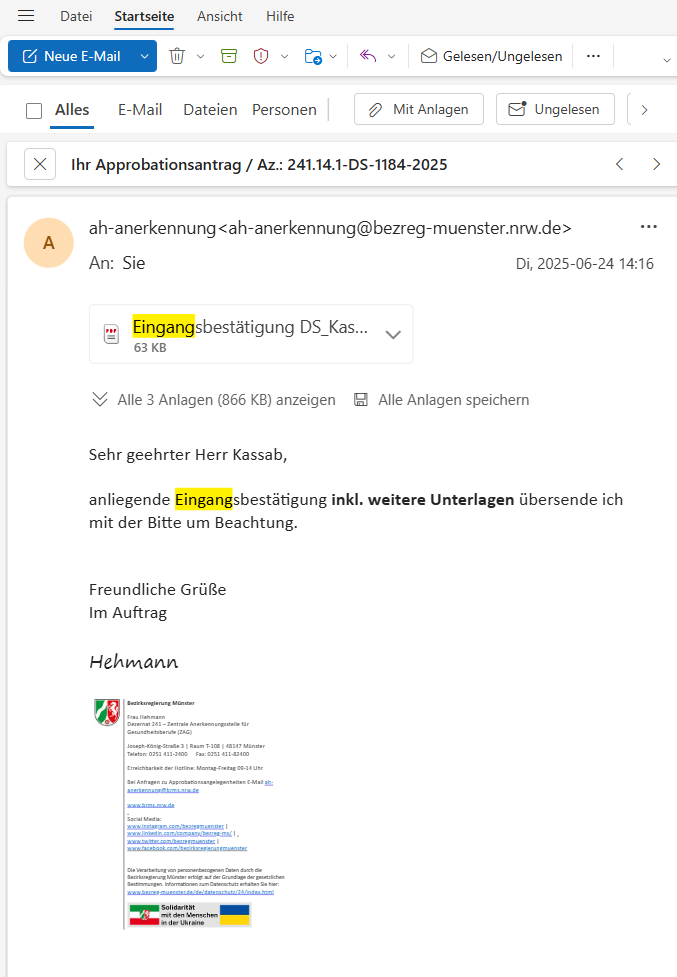
Obtaining the Eingang Acknowledgement of receipt
Once the documents have been received by the correction center, you will receive an email with an attached file named "Eingangsbestätigung," which is known as the "Eingangsbestätigung.".
The Aingang file is the official confirmation that the documents have been received by the amendment center, at which point the formal review process begins. You can view a sample Aingang file in the File and Form Library. From here.
The duration of obtaining the Eingang varies from one experience to another. It can be said that the duration usually ranges from several days up to about two months.
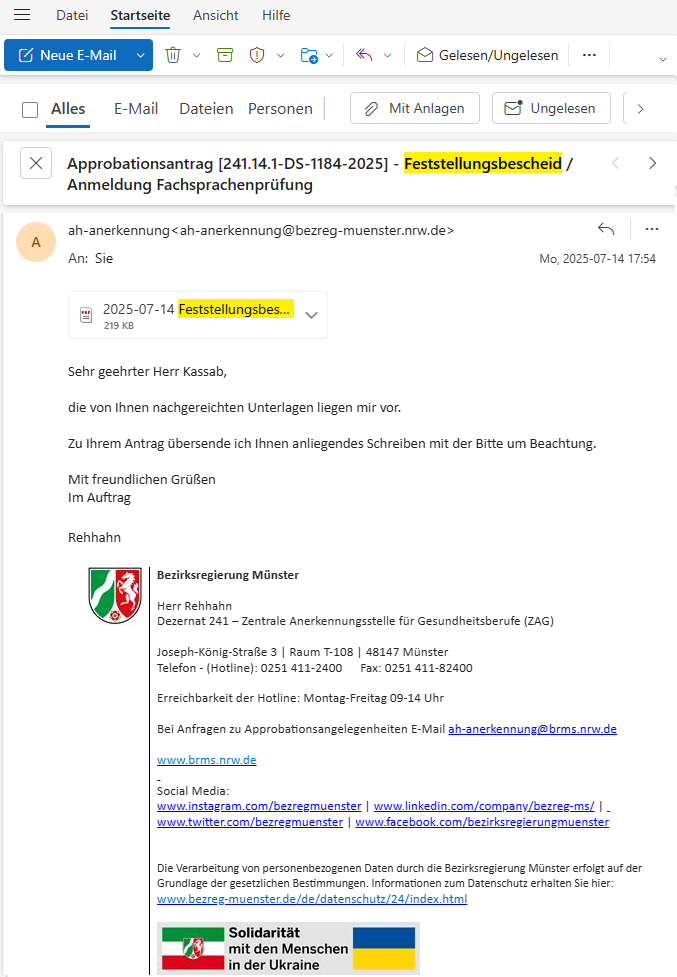
Getting Bishaid Determination notice
You will receive an email from the Equivalency Center some time after you receive your Einheg, as shown in the following image. Attached to the email will be a document called a Feststellungsbescheid, or “Bescheid.” This document is an official notification stating that your degree is eligible for equivalency in Germany. You can view a sample of the Bescheid in the file and form library. From here.
Locating the Occupational English Test (OET) venue
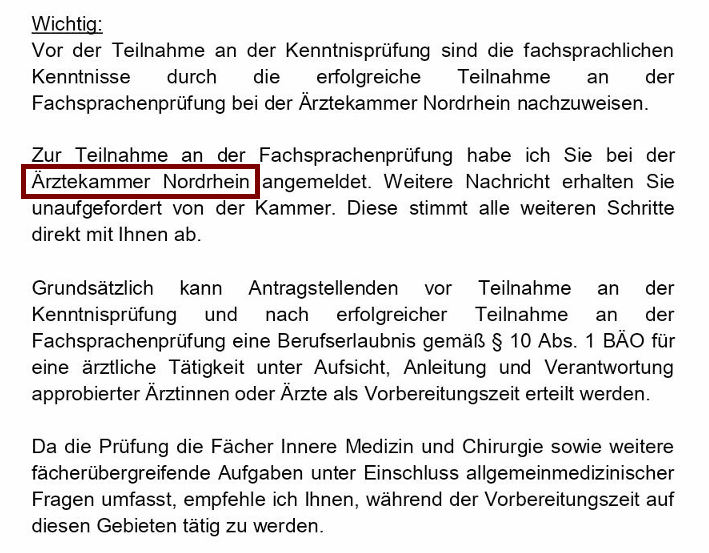
The Bechayde file specifies where the medical language exam will be held—either in Düsseldorf or Münster in the state of North Rhine-Westphalia. The exam is administered either by the Düsseldorf Medical Association (Ärztekammer Nordrhein) or by the Münster Medical Association (Ärztekammer Westfalen-Lippe). As shown in the following image, if “Düsseldorf” is specified, the exam will be administered by the Ärztekammer Nordrhein; however, if “Ärztekammer Westfalen-Lippe, there is no need to worry, as you can contact the Center for the Recognition of Medical and Pharmaceutical Degrees in North Rhine-Westphalia and provide proof of residence in a city under the jurisdiction of the Düsseldorf Medical Association; the exam location may then be changed. It is important to note that a change in the exam location is not guaranteed; while some attempts have been successful, others have not.
Proof of ties to the state
Residents outside Germany must prove their connection to the state of North Rhine. This is done by contacting the ZSBA office after obtaining the EinGang. I have uploaded a document to the File and Form Library prepared by Dr. Samih Kajak. This document is primarily useful for those who wish to submit their application to the state of North Rhine-Westphalia for the first time and are not residents of Germany, Click here to view the file.
Residents of Germany can prove their connection to the state by submitting one of these three documents:
- A job offer in North Rhine-Westphalia (Stellenzusage in Nordrhein-Westfalen) means that a person has received a job offer from a chief physician (Chefarzt) at a hospital or clinic; this option is difficult to obtain without a personal connection.
- Proof of Residence in North Rhine-Westphalia (Meldebescheinigung über Wohnort in NRW).
- A certificate of attendance (Hospitationsbescheinigung) for a period of at least 14 days or proof of a practical internship (Praktikum) in the state of North Rhine-Westphalia.
These documents are submitted as ordinary, uncertified copies and are accepted by the Regulatory Authority.
Steps after arriving in Germany
Preparing the required documents for the medical language exam at the Düsseldorf Medical Association
First, you need the documents required to register for the exam, the most important of which are a B2-level language certificate and proof of residence, also known as a “mildana.”.
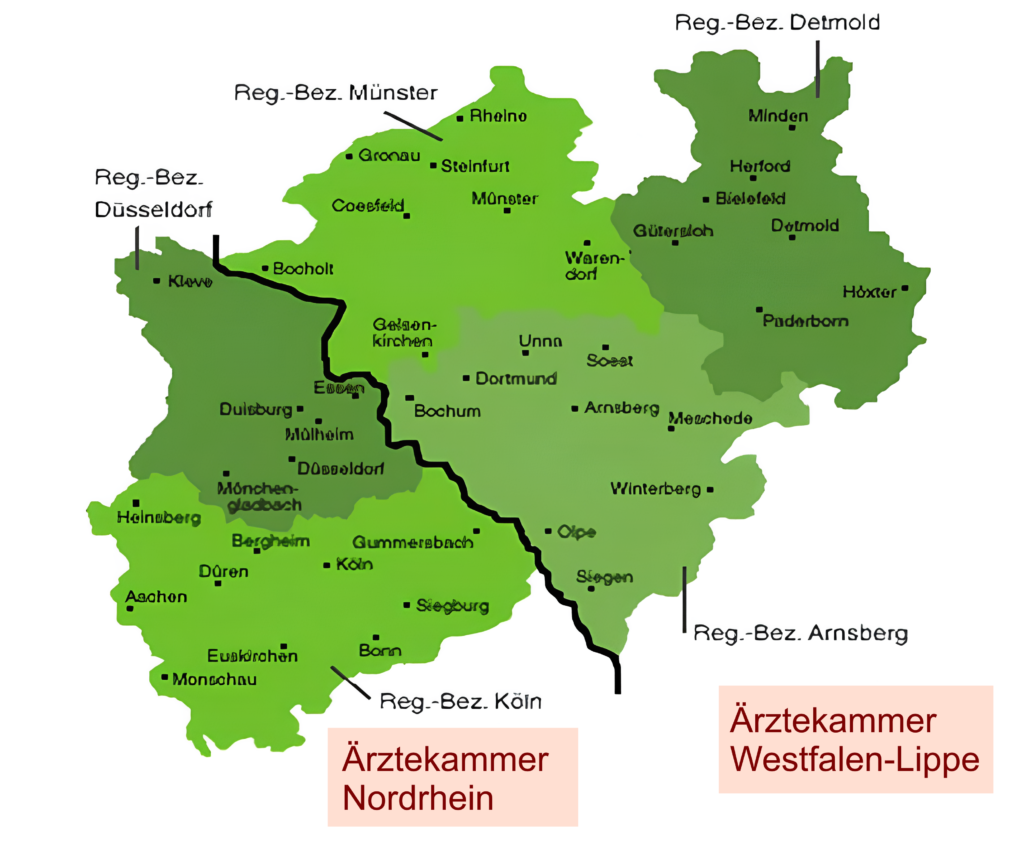
The first step after arriving in Germany is to register your residence, which must be in a city that falls under the jurisdiction of the Düsseldorf Medical Association, as shown in the image illustrating the cities under the jurisdiction of Düsseldorf and Münster. The medical association in Düsseldorf is the Ärztekammer Nordrhein, and the medical association in Münster is the Ärztekammer Westfalen-Lippe.
The second step is to take the German language B2 level exam. I previously shared my personal experience regarding the German embassy interview, where I booked the B2 exam instead of enrolling in a B2 course, and this was accepted by the German embassy and I obtained the German visa. You can benefit from my experience by booking the ibz package in the city of Dortmund.
Register for Language Courses at the IBZ Institute — Dortmund
I will explain in detail how to register for language courses at the IBZ Institute in Dortmund through the two packages it offers to residents both inside and outside Germany.
IBZ Institute visa package for Germany
The IBZ Institute helps you in the same way it helped me obtain my German visa, saving you time and money. The IBZ Institute offers a comprehensive package for levels B2 and C1. Here are the key benefits you’ll enjoy when you enroll at this institute:
- The person is registered directly for the B2 exam instead of enrolling in the long B2 course.
- Upon passing the B2 exam, the institute enrolls the student in the next available C1 course to prepare for the medical language exam.
This medical language course costs 1,450 euros and is funded by the Employment Agency at no cost to you. This helps you save time that you would otherwise spend on a part-time job, which would take away from the effort needed to prepare for the medical language exam. Given that this course lasts only 3 months, it is a suitable option compared to other, longer courses funded by the Employment Agency, which can last up to about 6 months. - The institute submits a funding application for the medical language exam on the individual's behalf, thereby saving the individual the 350-euro exam fee.
- The person receives a 300-euro voucher to purchase a tablet as part of the same package.
- The price of this package for residents outside Germany is approximately 880 euros; in practice, the package covers the B2 exam fee, which is about 200 euros. It also covers the €1,450 fee for the medical language course and the €350 medical language exam fee. In addition, the package includes a €300 tablet voucher. Therefore, it can be said that the person here is paying the fees for their own benefit, as they directly benefit from them, rather than paying fees for B2 and C1 courses at a language institute, which could amount to as much as 2,000 euros, followed by a 200-euro fee for the B2 exam and a 350-euro fee for the medical language exam.
You can register for this program, pay the fees from Germany, and secure housing near the course location that meets the German embassy’s requirements. For inquiries or to contact us, please use the following WhatsApp numbers:
IBZ Institute package for residents in Germany
Residents of Germany can also enroll at the IBZ Institute, and here we distinguish between two situations:
- If a person has not yet passed the B2 exam, they can take the B2 exam at the IBZ Institute itself or at another institute. Once the exam results are released, the person can enroll in a C1 course at the IBZ Institute to prepare for the medical language exam. In doing so, they will receive free coverage of the course fees (1,450 euros) and the medical language exam fees (350 euros), as well as a 300-euro voucher to purchase a tablet.
- If a person has passed the B2 exam, they can enroll directly in a C1 course at the IBZ Institute. The institute will then arrange for them to enroll in the next available C1 course. This person will receive free coverage of the course fees, totaling 1,450 euros, and the medical language exam fees, totaling 350 euros. In addition, the person receives a voucher worth 300 euros to purchase a tablet as part of the same package.
You can sign up for this package via the following WhatsApp numbers:
[ For more details on booking an IBZ course, you can read the article Course booking and proof of accommodation for the German embassy interview, as you can also watch the following video on my YouTube channel ]
Registration for the medical language exam at the Düsseldorf Medical Association
Once you have obtained these two documents, you can easily register for the medical language exam; simply provide a photocopy of your B2 certificate and the form—standard black-and-white photocopies without certification are acceptable. Next, fill out the application form for the exam (Antrag auf Teilnahme an der Fachsprachenprüfung), which you can download from the file and form library. From here.
These three documents must be mailed to the following address: Bezirksregierung Münster, Dezernat 241 – ZAG aH, Domplatz 1-3, 48143 Münster. I would like to point out that this address is in Münster, but it is the address of the Adjustment Center and has no connection to the location where the exam will be administered.
Pay the fees and schedule the exam appointment
After that, the person receives an email from the testing center asking them to pay the exam fee and suggesting the time period in which they would like to take the exam.
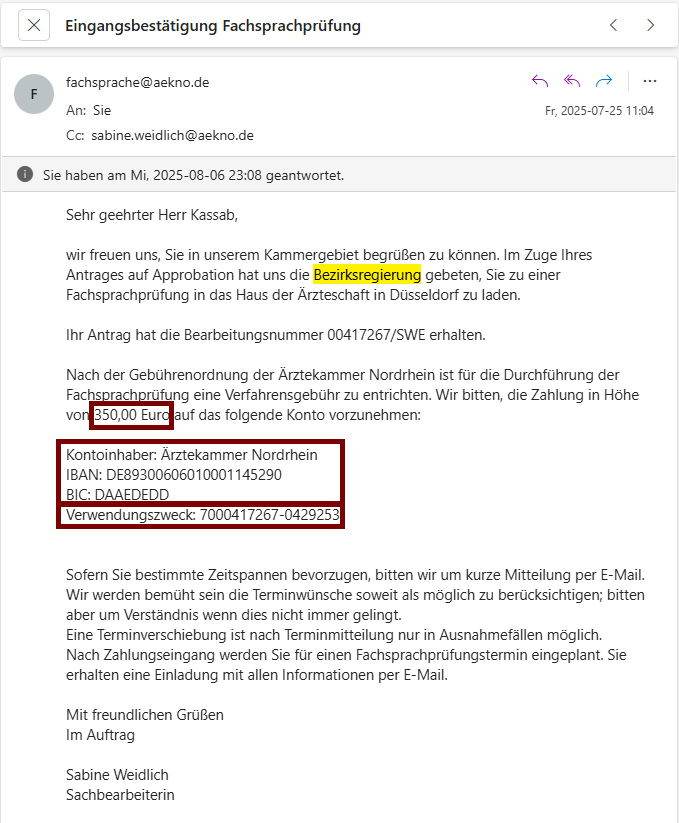
The person pays the fees to the bank account indicated in the previous image. It is very important to enter the transfer reason correctly when making the transfer, as the image shows a special number for each applicant, and this number differs from one person to another.
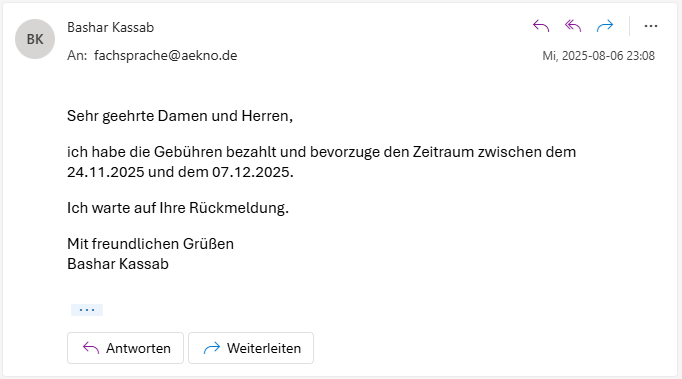
After paying the fees, the person replies to the same email, where it is important that the subject line remains the same. The applicant specifies here the period in which they wish to take the exam. It is generally known that the earliest available dates are 3 months later.
Notify the applicant of the exam schedule and request confirmation
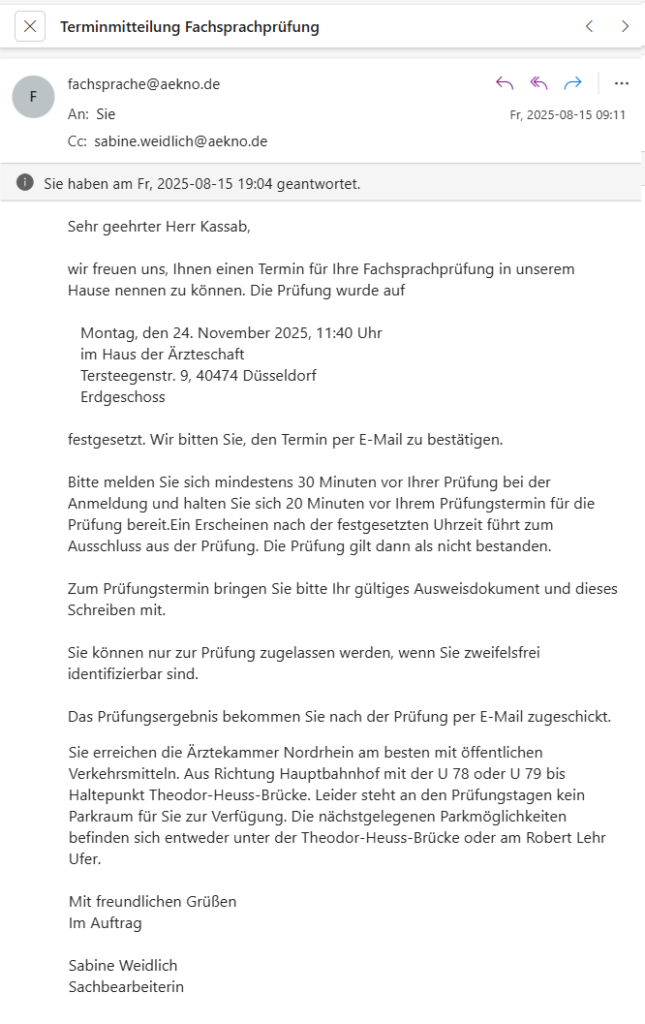
After that, an email arrives from the licensing center stating that the exam date has been scheduled and asking the applicant to confirm the appointment. The email includes the address of the Medical Association where the exam will take place. As shown in the image, public transportation options that can be used to get to the exam location are displayed. The email also explains that the exam result is sent to the applicant via email. This is usually about an hour after the exam ends or on the very next day.
Here, the applicant must reply to this message to confirm the appointment, and then begin the actual preparation for the exam, which is the subject of the next paragraph.
Preparing for the medical language exam at the Düsseldorf Medical Association
Almighty God has blessed me with preparing a comprehensive preparation file for the medical language exam in Düsseldorf. I will also explain the cases related to the exam successively on My YouTube channel. I am available to provide a paid consultation in case someone encounters any issues while preparing for the exam, and you can contact me via WhatsApp number.
I worked continuously for more than a month to organize the Medical Language Exam protocols in Düsseldorf, North Rhine. I found that the previously available files did not present the cases properly for study, so I made sure to avoid these issues in this comprehensive guide through the following:
- Completely redesign the way protocols are displayed so that each answer provided by the patient appears in its designated section within the clinical history questions.
- Displaying the protocols in an organized manner that helps, first, to identify cases and, second, to systematically practice asking questions.
- Classify patient questions and committee questions into separate sections with appropriate answers for each case, such that the patient answers are in simple, non-specialized language and the committee answers are in specialized medical terminology.
- Add the latest experiences, including all 2026 experiences, with the inclusion of new conditions such as diverticulitis.
- Compile foods, professions, medications, and explanations of medical clarification procedures (Aufklärung) into dedicated tables at the end of the file to serve as a reference for continuous review.
- Create tables of medical abbreviations and compile the most important terminology for the Düsseldorf exam into a custom study package for Anki.
Steps after passing the medical language exam
A person can transfer their file immediately after passing to another federal state or choose to work as an assistant doctor in North Rhine. It is possible to work for two years on a temporary license within the state, and after this period ends, the file can be transferred to another federal state.
Naturally, I do not recommend taking the Kenntnisprüfung exam in Münster, despite some people's courage in attempting it. Since the exam is still difficult, in recent experiences, if a person fails the exam, their temporary medical license is revoked.
Steps to withdraw the file from MCenter for the recognition of medical and pharmacist degrees in North Rhine
The steps are simple, as the person first fills out a file withdrawal application (Antragsrücknahme), which is then sent by mail to the address of the evaluation authority found inside it, and you can download the application from the file and form library. From here.
After that, the person receives a message from the amendment center containing an invoice to pay the file withdrawal fee. Inside the attached file in the message, the required amount to be transferred appears along with the bank account information to which the amount should be transferred, in addition to the appropriate transfer reason.
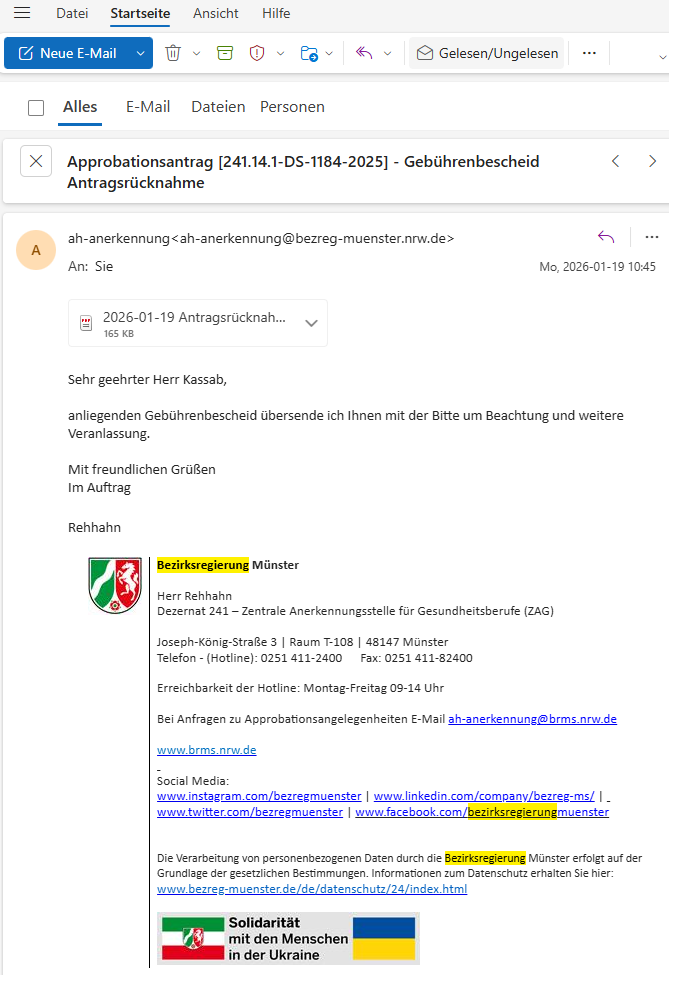
After payment, the person takes a screenshot of the payment notification from the bank account, and then, after choosing the state to which the documents will be sent, attaches the file withdrawal receipt along with the payment notification and the rest of the required documents.
What I recommend regarding the state that should be chosen is the state of Lower Saxony (Niedersachsen). I will prepare a special video about this state explaining the steps and required paperwork.
Applying for the final medical and pharmaceutical equivalency exam in North Rhine
Doctors and pharmacists can apply for the final license recognition exam in the state of North Rhine. This is done by completing the special application for the exam, which can be downloaded from the files and forms library. From here.
Conclusion
In the end, it can be said that choosing the state of North Rhine is considered one of the best decisions for the equivalency of doctors' and pharmacists' degrees. This is due to the flexibility this state provides in the equivalency procedures, in addition to the possibility of processing the file without the requirement of being present inside Germany. Furthermore, there is the most important reason, which is that the medical language exam in Düsseldorf is considered one of the easiest exams in Germany.
For all these reasons mentioned, the state of North Rhine remains the balanced choice that gives foreign doctors and pharmacists a strong start within the German medical system, before moving on to the final step of applying for the final certificate equivalency exam.